AI Is a Change Management Problem, Not a Technology Problem
by Sean Worthington | 27/08/2026If you've spent the last year trying to get AI to actually move the needle in your business and you're standing there wondering why all you've got is a few enthusiastic early adopters and a lot of quiet disengagement everywhere else … you're not doing anything wrong. In fact, in our experience – backed up by lots of evidence – you're in the majority.
McKinsey's latest "State of AI" research found that 44% of organisations now say they're scaling AI across the enterprise, up sharply from last year. How many are reporting a real bottom-line impact? Essentially unchanged. Only 6% of companies see AI meaningfully move their EBIT. Adoption is up. Value isn't. It is pretty clear something in the middle is broken.
It's not the models. The models are, by any reasonable measure, extraordinary. The problem is that most organisations are still treating "getting value from AI" as a procurement decision – buy the tool, roll it out, run some training, hope for the best – when it's actually a change management programme. And the data on why that gap exists is now clear enough to act on.
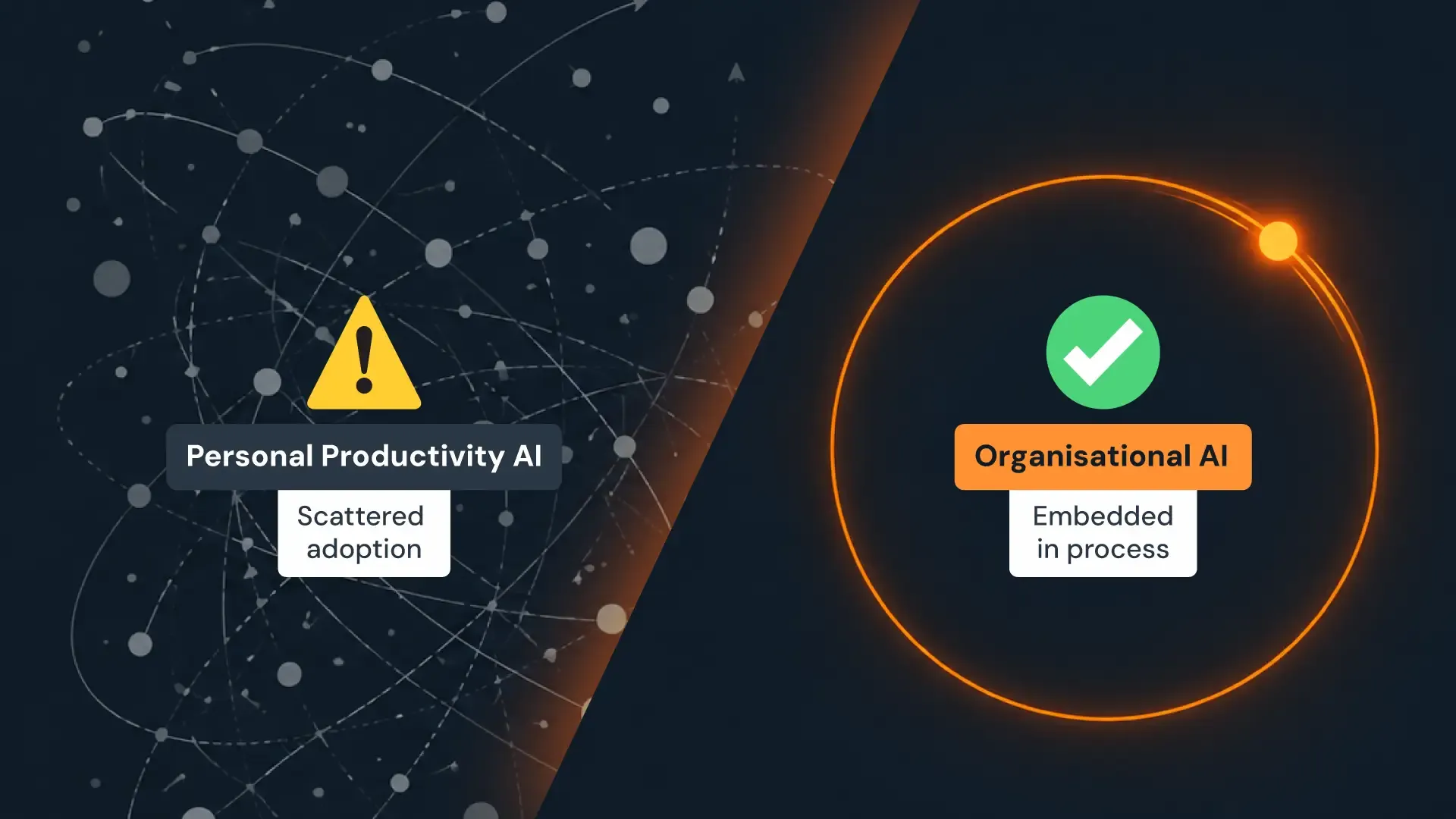
Start with an important distinction: Personal Productivity AI versus Organisational AI.
Personal Productivity AI is a tool handed to an individual – ChatGPT, Copilot, a bespoke internal assistant – that your teams have to personally learn, trust, and choose to use differently every day. Organisational AI is different: it's AI embedded directly into a business process, running inside a workflow that already exists, without requiring dozens or hundreds of people to individually change their habits.
Here's what's striking: MIT's NANDA initiative, in the report behind the much-quoted (and widely misread) "95% of AI pilots fail" headline, found that the 95% figure applies specifically to custom-built enterprise copilots – bespoke tools commissioned for a department and handed to its staff. Meanwhile, 90% of employees were already using personal AI tools like ChatGPT for work, and general-purpose tools reached genuine production use 40% of the time. That's eight times more often than the purpose-built enterprise versions, which succeeded only 5% of the time.
At first that looks like a puzzle: why would an expensive, custom-built enterprise tool underperform a free consumer one? Well, both are still Personal Productivity AI. Both require an individual employee to open a new tool, learn its quirks, and change what they do at their desk. The only difference is who bought it – and the custom version is usually less flexible, less familiar, and more brittle than the tool people already like using. Same change management burden, worse experience.
The genuinely interesting finding is buried a layer deeper. The same report highlights back-office automation cases – where AI was embedded directly into a process, such as replacing an outsourced workflow, rather than handed to a room full of people as a new tool to learn – that delivered $2–10 million in annual savings, quietly, without needing mass individual adoption at all. That's Organisational AI. The change management burden shrinks not because it's "enterprise" or expensive, but because you're changing the process once and letting the AI run inside it, instead of asking two hundred people to change their daily habits.
That's not a reason to abandon Personal Productivity AI – plenty of real value lives there too. But it explains why so many AI rollouts feel like pushing water uphill: leaders are budgeting for a software purchase when they're actually running a training and behaviour-change programme across an entire workforce, and they haven't resourced it as one.
Three other patterns from this year's research point the same way.
Workflow redesign beats tool deployment.
McKinsey's high-performing organisations (the ones actually seeing financial impact) redesign the workflow around AI 74% of the time, compared with just 25% of everyone else. Dropping a new tool into an unchanged process is close to a guaranteed miss.
Guidance and time matter more than access.
BCG found only 36% of employees feel adequately trained on AI, and 18% of regular AI users say they received no training at all. Only 25% of employees say leadership gives them enough guidance on how to actually use it well.
Expectations and sponsorship decide outcomes.
Gartner's research among infrastructure and operations leaders found 57% of those who reported an AI project failure traced it back to leaders expecting too much, too fast – rolling AI out and expecting it to fix long-standing operational problems immediately, rather than treating it as a programme with its own ramp-up.
In summary
Put together, none of this describes a technology gap. It describes a well-understood, well-documented set of organisational and behavioural problems, which is actually good news: redesigning a process once and letting AI run inside it is a faster, simpler fix than trying to get two hundred people to permanently change how they work. You don't need to wait for a better model. You need a clearer view of which parts of your business can be changed once, at the process level, and which genuinely require individual behaviour change — and the leadership bandwidth to resource both properly.
If any of this sounds familiar – "plenty of activity, not much impact" and a nagging sense that it's more about people than technology – you're reading the room correctly, and it's more fixable than it feels right now. We'd be happy to just talk it through with you. No pitch, just a conversation.
Sources:
- Fortune, "An MIT report that 95% of AI pilots fail spooked investors." (2025)
- McKinsey, "The State of AI in 2026: On the Road to ROI" (August 2026)
- BCG, "AI at Work 2025: Momentum Builds, But Gaps Remain" (June 2025)
- Gartner, AI project ROI research among infrastructure and operations leaders (April 2026)
