AI Won't Fix a Broken Process – It Will Just Break It Faster
by Sean Worthington | 20/08/2026Many of the leaders I speak to these days are asking a version of the same question: "What’s our AI play?". It manifests in different ways:
- “Are you building AI into the system you are building for me?”
- “Do you think AI would work here?”
- “How do we deliver the efficiencies AI is purporting to deliver?”
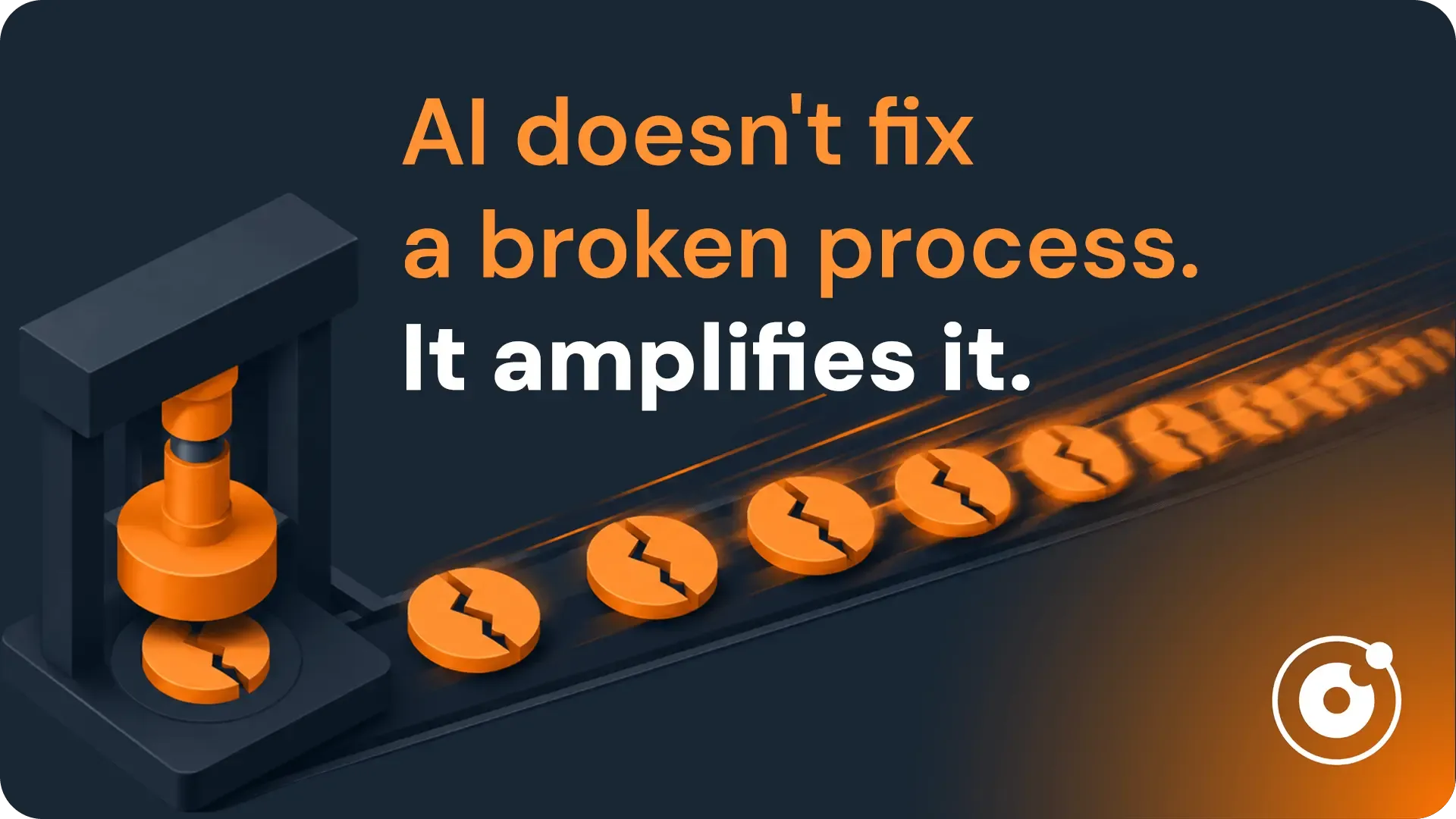
Whilst that is the right instinct the questions are already loaded with an assumption – that AI is the thing that will make the business faster or leaner or … just … better. We find ourselves explaining an uncomfortable truth: AI, alone, doesn’t fix anything, but it will tend to amplify whatever you point it at.
Where AI Genuinely Helps - and Where It Makes Things Worse
Point it at a well-designed and ‘capability-matured’ process and it tends to be genuinely transformative, delivering higher throughput, fewer errors or freeing people up for the work that actually needs a human. Point it at a poor or broken process and you don’t get a fixed process. You get a broken process running ten times faster, producing more of the wrong thing, more confidently, potentially at greater cost. Furthermore, when you automate a broken step, you don’t just live with the dysfunction – you bake it in. The cludged workaround disappears behind a slick interface. The bottleneck gets a shiny new coat of paint. And because the output looks polished, nobody stops to ask if the underlying process still makes sense. A problem you could once see and fix is now buried under a layer of automation that everyone waves away as "the AI, doing its thing."
The right approach is to understand your process well enough to know where AI genuinely helps – and, just as importantly, where it quietly makes things worse. That’s a discipline, not a technology.
How to Find the Real Constraint
In practice it looks like this: map how the work really flows, not the unreferenced flowchart in your process folder, but the messy reality. Find the actual constraint – the one bottleneck that’s genuinely holding you back, not the ten irritations that merely annoy people. Only then, choose the right intervention. Sometimes that’s AI. Sometimes it’s actually plain, unglamorous automation or what we call deterministic code. And sometimes it’s simply fixing the process so that no new technology is needed at all.
That last one matters more than it sounds. Some of the most valuable advice we give a client, once we’ve had the bonnet up on their processes is that they don’t need the expensive AI project they walked in asking for – they need to fix the handover between two teams. That’s not a message you’ll ever hear from a vendor whose only product is AI.
Diagnosis and Delivery: Why Most Firms Can Only Do One
At NewOrbit, this is the part we’re a little obsessed with. We’re process-optimisation geeks – we genuinely enjoy pulling a tangled operation apart and finding the constraint that everyone else has stopped noticing. But we also have the technical chops to build the thing that fixes it, whether that turns out to be an AI capability, a system integration, or a custom application. Most firms can only do one half. The strategy people hand you a slide deck and wish you luck; the development shops build whatever you spec, brilliant or broken. The value is in doing both – diagnosing the real problem and then actually delivering the technology that solves it.
Because AI is only ever as good as the process it runs on. Get the process right and AI becomes a real multiplier. Get it wrong, and all you’ve bought is a faster way to break things.
So if you’re under pressure to "do something with AI", start with a better question: is the process underneath it any good? We’d love to help you answer that honestly – and then build whatever that honest answer turns out to need.
NewOrbit helps organisations optimise the way they work and deliver the technology to make it stick. Before you commission an AI project, let us take a look at the process it's meant to fix. We'll tell you honestly whether AI is the answer, or whether something simpler will do.
