What Your Competitors Are Actually Doing With AI (And What They’re Not)
by Sean Worthington | 17/11/2026MDs I get to spend time with tend to ask me a version of the same question, usually a little sheepishly, near the end of our AI conversations: "Are we falling behind the AI curve?"
It's a fair question – we're not all out there measuring what AI is doing for our competitors. But we are hearing a lot. We see their showreel and focus on our own blooper reel. Standard. Fear of missing out is a powerful motivator. It's also a terrible strategist.
So I did some AI-assisted research to help me understand what businesses like yours are doing with AI – and, more importantly, what they're not.
What they ARE doing: lots of it, quite lightly
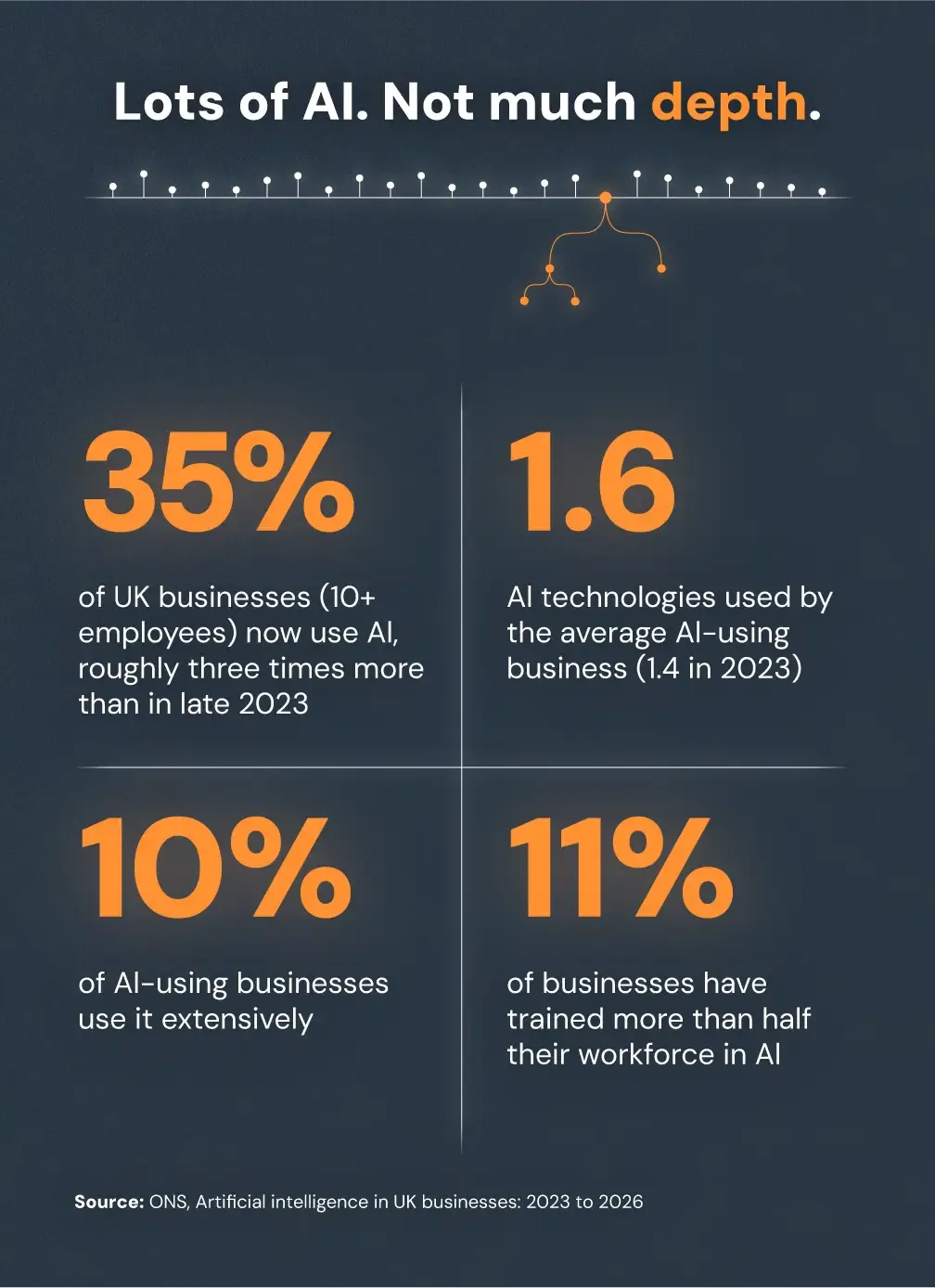
The headline numbers are real. In a British Chambers of Commerce (BCC) survey, 54% of firms – almost all of them SMEs – said they're actively using AI, up from 35% a year earlier and 23% in 2023. The Office for National Statistics (ONS) uses a different measure, covering businesses with ten or more employees, so its figure is lower. But the trend is the same: AI use has roughly tripled since late 2023, to around 35%.
So yes – a lot of your competitors are "using AI". But look one layer down and the picture changes.
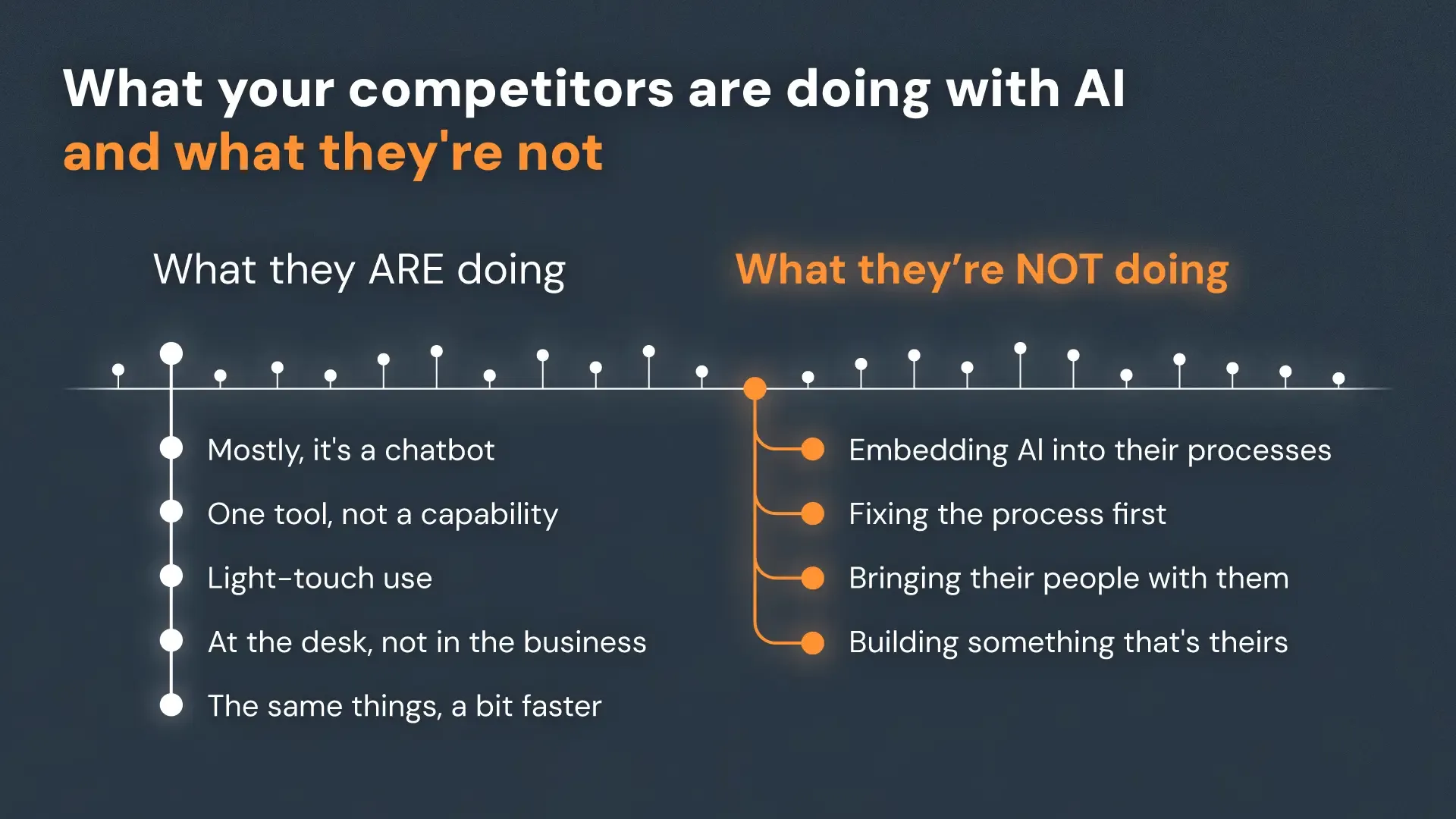
- Mostly, it's a chatbot. Large language models – ChatGPT, Copilot, Gemini and friends – are the most common AI technology businesses use. In several sectors I researched, it appears the most common way in is simply free software.
- It's one tool, not a capability. The average AI-using business uses just 1.6 different AI technologies, barely up from 1.4 in 2023.
- It's light-touch. Only around one in ten businesses using AI say they use it extensively. The BCC found only around one in ten SMEs have gone beyond generic tools to adopt bespoke AI.
- It's happening at the desk, not in the business. Around half of employees say they use AI for work or study, compared with around 35% of businesses that report using it. A lot of "AI adoption" is individuals quietly using a chatbot to write emails faster – not the business changing how it works.
- It's mostly about doing the same things a bit faster. Improving existing operations is by far the most common use. Using AI to develop new products, services or markets is much rarer.
None of that is a criticism. Staff using AI to save time is genuinely useful. But it isn't a competitive advantage – because everyone has access to exactly the same tools – it's keeping up.
What they're not doing
This is the part the headlines miss. Very few businesses have done the harder, less glamorous work that actually turns AI into an edge.
They haven't embedded AI into their processes. I've written before about the difference between Personal Productivity AI – a tool you hand to individuals and hope they use well – and Organisational AI, where AI is built into a business process and runs inside it. Most of what's happening out there is the first kind. The second kind is where the real returns tend to sit, and it's still rare. (More on that in AI Is a Change Management Problem, Not a Technology Problem.)
They haven't fixed the process first. Dropping AI into a workflow that's already clunky just gets you a faster clunky workflow. AI amplifies whatever it touches – the good and the bad.
They haven't brought their people with them. Only 11% of businesses say more than half their workforce has had any AI-related training. Tools without guidance mostly gather dust – or worse, get used in ways nobody has thought through.
They haven't built anything that's theirs. If you and your competitors are all using the same off-the-shelf assistant, you've all bought the same advantage – which is to say, none. The distinctive value is in AI shaped around your data, your processes and your customers. (I made that case in The Hidden AI Opportunity: Why Custom AI Beats Off-the-Shelf for Growing Businesses.)
From FOMO to JOGA
Here's why I find all this genuinely encouraging.
If your competitors were already deep into embedded, process-level AI, you'd have good reason to worry. But mostly, they're not. By and large they're where you probably are: some enthusiastic individuals, a few subscriptions, and a nagging sense that there must be more to it.
Which means the gap that really matters hasn't closed. It's barely opened.
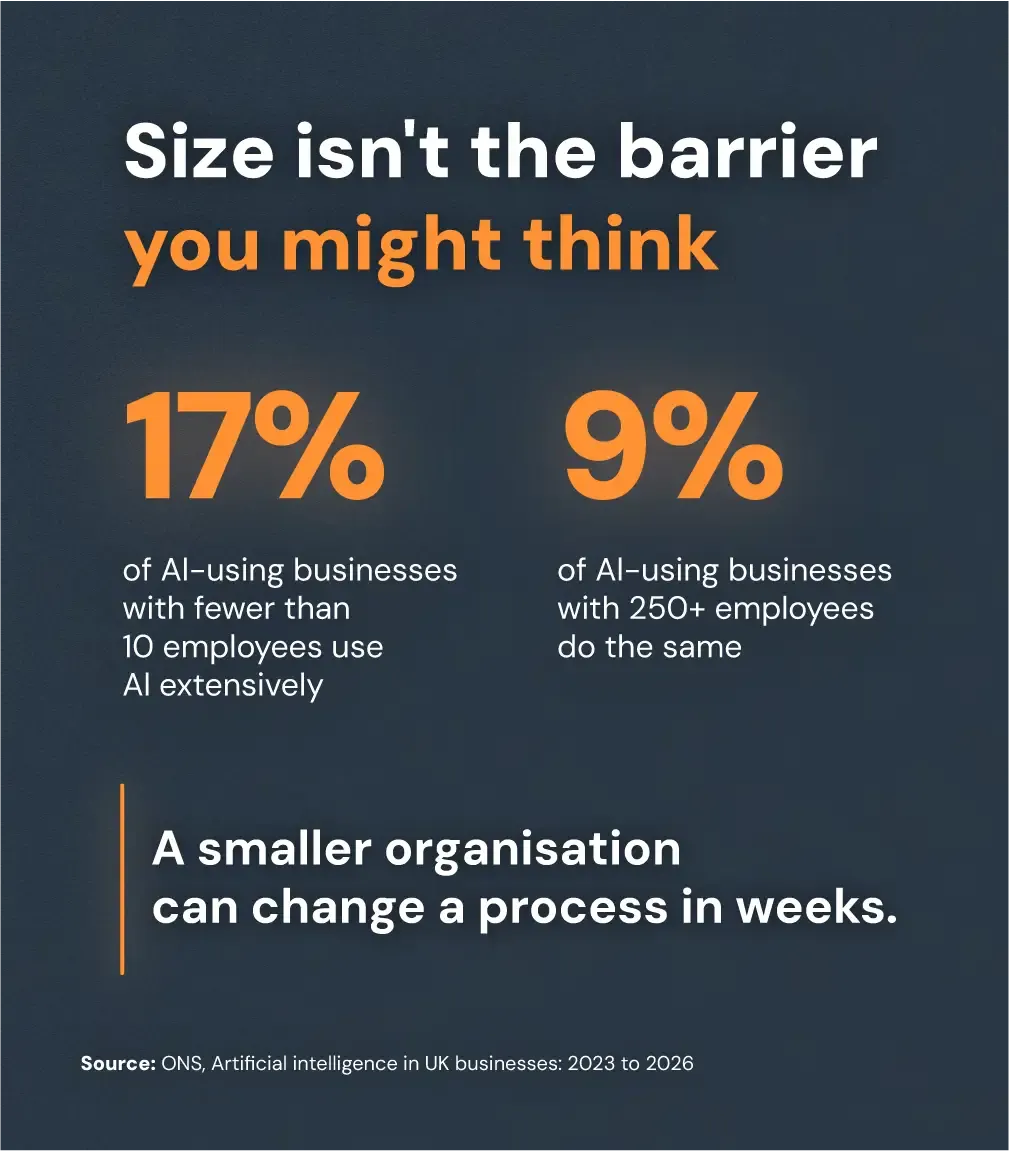
And size isn't the barrier you might think. Early ONS data suggests that, among businesses using AI, the smallest (fewer than ten staff) are more likely than the largest to say they use it extensively – 17% versus 9%. A smaller organisation can change a process in weeks where a large one needs a year of committees. That's an advantage, if you use it.
So rather than fear of missing out, I'd suggest something more useful: the joy of getting ahead. JOGA, if you like. (Totally made up for the purposes of this article, but I'm going to use it from now on.)
Three moves that put you ahead
You don't need a grand AI strategy to start pulling away. You need to do a few things most of your competitors haven't.
- Pick one process, not one tool. Find something repetitive, painful and important – something that genuinely matters to your customers or your margins. Then ask how AI could change that process, rather than which tool your team should use.
- Fix it before you automate it. Map it honestly. Find the real constraint. Then decide where AI helps – and where a simpler fix would do the job. (I go into this in AI Won't Fix a Broken Process – It Will Just Break It Faster.)
- Give people room to experiment – with sensible guardrails. Lock AI down and it goes underground; leave it wide open and you get fifty pilots and no shared learning. A light structure that tightens as the stakes rise gets you the best of both. (See Where AI ideas go to die (and how to stop it).)
Do those three well and you'll be doing something the large majority of your competitors haven't yet.
The honest answer
So, are you behind? Probably not as far as you fear. Most businesses are still at the "everyone's got a chatbot" stage.
The real question is whether you'll still be there in a year's time – or whether you'll have used this window to build something your competitors can't simply buy.
If you'd rather spend the next year on JOGA than FOMO, we'd be happy to talk it through. No pitch, just a conversation.
Sources
- Office for National Statistics, Artificial intelligence in UK businesses: 2023 to 2026 (July 2026)
- British Chambers of Commerce, Half of SMEs Using AI – With Limited Headcount Impact So Far (March 2026)
- D. Bharier, B. Etheridge and P. Morais, AI Adoption and Workforce Change in SMEs, ISER Working Paper 2026-01, University of Essex (March 2026) – analysis of the BCC / Atos survey data
- IT Brief UK, Most UK firms now use AI as SMEs see roles unchanged (March 2026) – bespoke-AI figure
